Erez Ella Matan Sapir -Final Project

Overarching problem about a wide-raging topic
“The individual has become a mere cog in an enormous organization of things and powers which tear from his hands all progress, spirituality, and value in order to transform them from their subjective form into the form of a purely objective life.”
-
Georg Simmel
By 2050 the world will reach 10 billion people, 70 precent of which will live in the large cities. Israel, a small and already dense country, is projected to go through an even more drastic transformation by then. Even before the pandemic, concern of this future had already existed. The tech revolution allowed people to leave the office, and The City, behind. It allowed them to piece themselves together anywhere in the world, nomadically. What is the threshold that separates the countryside and the city, and do we really have a choice?
There are many ways to make sense of events beylond our immediate control. The most convincing explanations seem to have a clear narrative arc - applicable to real world circumstances ranging from policy debates to technological projections. The Science Fiction genre might as well have been described as ‘speculative fiction’ and doesn’t have anything to do with ‘science’ at all. Instead, it is more concerned with the general principles of life and associated imagined consequences. Understanding The medium of fiction allows us to speculate as a response to a phenomena or a discovery. Only then can these be debated, or taken apart. In a sense, a public narrative should not be received as definitive, but as the starting point of the story. What is the stated dilemma, context or motive for any one of these problems? And most importantly, how does the formulation of a problem determines its proposed solution? Perhaps, the best way to understand our future is through narratives that distort, pervert and animate reality.

Status Quo and Initiale Problem
Starting with Gustav Freytag’s familiar narrative form structures a storyline from a stated problem’s point of origin to its compounding factors and ultimate resolution. This organization, often retroactive, allows for a believable argument to be made about contentious issues, disputed causal effects and untested solutions.
In the first stage, the exposition/introduction, we establish time and place and the mood, or atmosphere of the story. The first dramatic arc enables us to know more about the circumstances and the relationship between or elements.
Here we establish our problem. The year is 2050 and the world has just reached 10 billion people, 70 precent of which live in the cities. This is the reality our character will have to deal with.
This is the rising action. It is where the basic conflict is brewing, and we beginning to feel the rising tension associated with this conflict. At this juncture, the basic conflict is further complicated by the introduction of obstacles frustrating the protagonist. Secondary conflicts are probably coming.
In our story the blasé effect gets out of control, and the city becomes unbearable. Rural areas are becoming more attractive.


Exposition\Context
Perched in the windows of the office blocks and department stores, the iguanas watched them go
past, their hard frozen heads jerking stiffly. Without the reptiles, the lagoons and the creeks of office
blocks half-submerged would have had a strange dream-like beauty, but the iguanas and basilisks
brought the fantasy down to earth. As their seats in the one-time board-rooms indicated, the reptiles
had taken over the city.’
– JG Ballard, ‘The Drowned World’, 1962
Technological advances allow people not to stay in one place, and understand that they are free to work, study and live from anywhere. New communities begin to emerge. People enjoy being on the road, working from home, and the global education their children receive.
Other frameworks call it the “inciting incident,” when some outside force or opportunity puts the protagonist into motion.


Complications and Crisis
Camps of this new movement are growing rapidly. And with it also the transportation system that connects them to the suburbs. People are increasingly using new transportation infrastructure to travel longer distances as communities become less compact.
Now that the chief action has been started, the story is being built toward the climax.
People’s lifestyles require an increasing amount of resources and time for maintenance as a result of inefficient spatial distribution. Larger communities lead to larger infrastructure built. They develop a culture, with new forms.
Things continue to either develop, leading up to the “force of the final suspense,” a moment before the catastrophe, when the author projects the final catastrophe and prepares the audience for it. Were close, but not there yet.


Climax
By creating great comics for kids, we can plant powerful seeds of change that will have a lifelong
impact and foster a new generation of global leaders, thinkers and doers to tackle the world’s most
pressing issues like climate change and inequality.’
– Stan Lee and Sharad Devarajan, ‘Comics Uniting Nations’, 2015
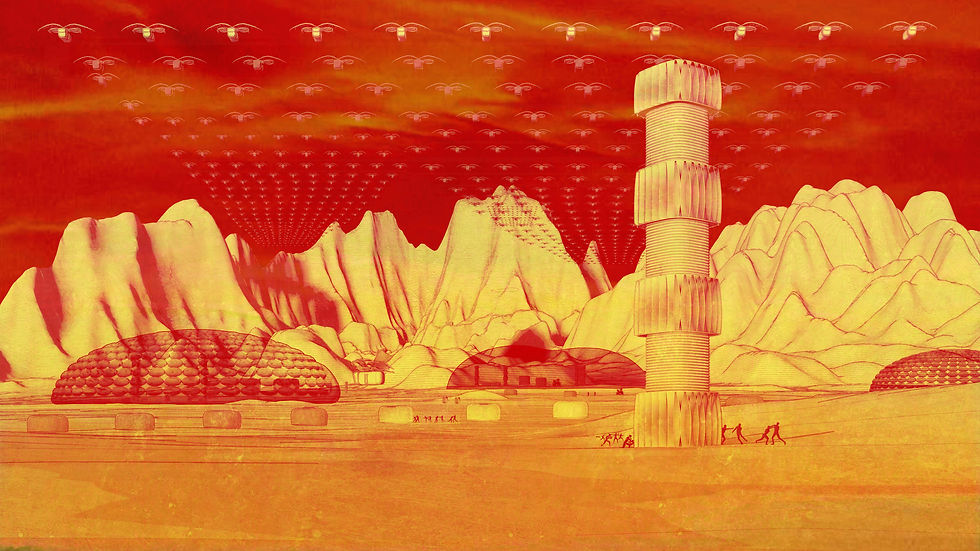
The year is 2063, and this economy of digital nomads is completely reliant on the drone transportation network for goods and supplies. Violence ensues. Something has to be done, otherwise it’ll all fall apart.
The climax is the turning point and this third arc effects a change either for the better or for the worse. In this framework, the climax can be thought of as a reflection point. If things have gone well for the protagonist, at the climax they start to fall apart tragically. The climax is the beginning of another act/scene and punctuated to separate it from the rising and falling action. It occupies the highest point, in the middle of the pyramid. It is still the point at which the story reflects and afterward becomes the mirror story, the counter-play.

Denouncement
‘There can be no doubt that engineering came into being to solve new problems of a new society,
but once engineering was established, there arose an interaction by which it in turn influenced
the evolution of society. This state of affairs continues today and will continue to exist as long as
civilization remains dynamic and maintains its evolutionary course.’
– Richard Shelton Kirby, ‘Engineering in History’, 1991
The year is 2065, an awareness develops that more sustainable alternatives are needed. In our story, the International Geographic Society’s parliament gathers to discuss a new method of operation. A hopeful solution to the problem. In other words, the development of a new status quo.
- By developing the country into basins (60% of which is desert landscape, called the Negev) they can determine population quantities according to rainfall - flood water.
- The Timna River Basin for example (about 22 square km) gets about 50mm of rain per year , which equates to 1,100,000,000 Liters of flood water. Even if a concervative 60% of that water is collected then it’s enough to supply 11,000 individuals. Far exceeding the 8,000 people polluting it at the moment.
- By creating a closed loop of water collection, filtration, and reservation (in the form of of a small dam, a solar dome, and using the old mimng pits of the area as a reservoir), this society is able to concentrate populations.


Description of the New Status Quo
‘Arrival of the Floating Pool after 40 years of crossing the Atlantic, the architects/lifeguards reach
their destination. But they hardly notice it due to the particular form of locomotion of the pool – its
reaction to their own displacement in water – they have to swim toward what they want to get away
from and away from where they want to go.’
– Rem Koolhaas, ‘The Story of the Pool’, 1977
A detailed overview of how this world operates. This is where the architect finds his\her design. It is the description of The New. Completed 2070
- this Oasis is possible because of the pneumatic dome covring the reservoir. It allows the water to stay inside, by protecting it from the desert sun, as well as allowing hot air caused by human activity to escape out, through the openings. The tempeture inside the pit is steady year round. That’s because of the fact that it sits so deep underground, its sides are always cool.
- This Garden of Eden allows these Dippies to exercise their fantasies without consequences. They are able to fulfill their previously developed lifestyle within a compact package, that is able to contain their wildest dreams and their basic needs. It becoms so unbelievably popular that it spreads around the globe, making it so common place, you could find it every where...

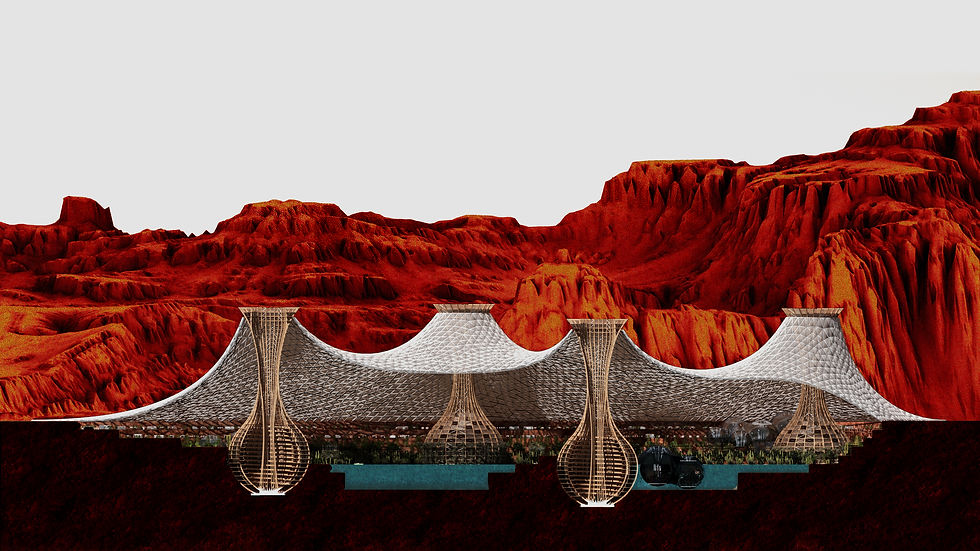

It becoms so unbelievably popular that it spreads around the globe, making it so common place, you could find it every where...

Description of the New Status Quo
A map of the world that does not include Utopia is not worth even glancing at, for it leaves out the
one country at which Humanity is always landing. And when Humanity lands there, it looks out, and,
seeing a better country, sets sail. Progress is the realization of Utopias.’
– Oscar Wilde, ‘The Soul of Man Under Socialism’, 1891
The key word is counter-play. The story reflects on itself and afterward becomes the mirror story. The conclusion is found at the lowest point of the paradigm following the falling action. It is the beginning of another act/scene and punctuated as distinct from the other parts of the dramatic structure. An open-ended system. A new project.


Colab with David joaks vassal